Why a Dress Photographs Differently Than It Looks in the Mirror
Quick Answer: A mirror shows you a life-size, reversed, binocular image at close range. A phone camera gives a flattened, wide-angle, single-eye image at a distance, usually from an unflattering height, under whatever light happens to be there. The main culprits are lens compression, camera height, and the fact that your brain heavily edits mirror images and does not edit photographs. The dress is fine; the two systems are measuring different things.
Before you return a dress because a photo of it looked wrong, it is worth knowing which of the two images is lying and by how much.
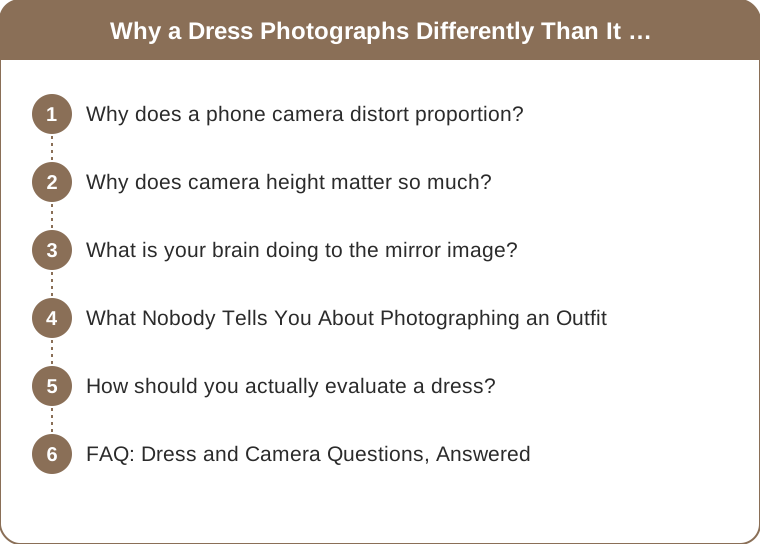
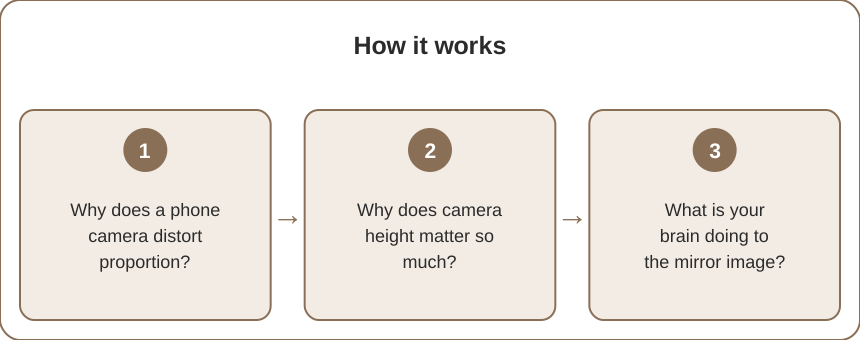
Why does a phone camera distort proportion?
Phone main cameras sit at a wide focal length - typically a 24-26mm equivalent. Wide lenses exaggerate the size of whatever is closest to the lens and shrink whatever is further away.
At arm’s length, that means your hand, your hip, or whichever body part leads is enlarged relative to everything else. Shot from below, feet and legs are nearest and get stretched or foreshortened depending on angle.
The fix is distance and focal length. Step back at least six feet, and use the 2x or 3x telephoto if your phone has one. Longer lenses compress rather than expand, which is why professional fashion images are shot at 85mm and up. The same dress at 24mm from three feet and 77mm from ten feet looks like two different garments.
Why does camera height matter so much?
Because the height of the lens sets the vanishing geometry of the whole body.
A lens below your waist makes the lower half read longer and the upper half smaller. Above your chest, the reverse. Neither is neutral.
Neutral is roughly chest height, or a little below. Most mirror selfies are taken with a phone held at chest to face height and tilted down, which shortens the legs and widens the hips - exactly the complaint people have about their outfit photos.
So a large fraction of ‘this dress makes me look wrong’ is ‘this phone was 14 inches too high and tilted 10 degrees.’ Prop the phone at chest height, level, and step back, and the complaint usually disappears.
What is your brain doing to the mirror image?
Editing it, constantly, and with your cooperation.
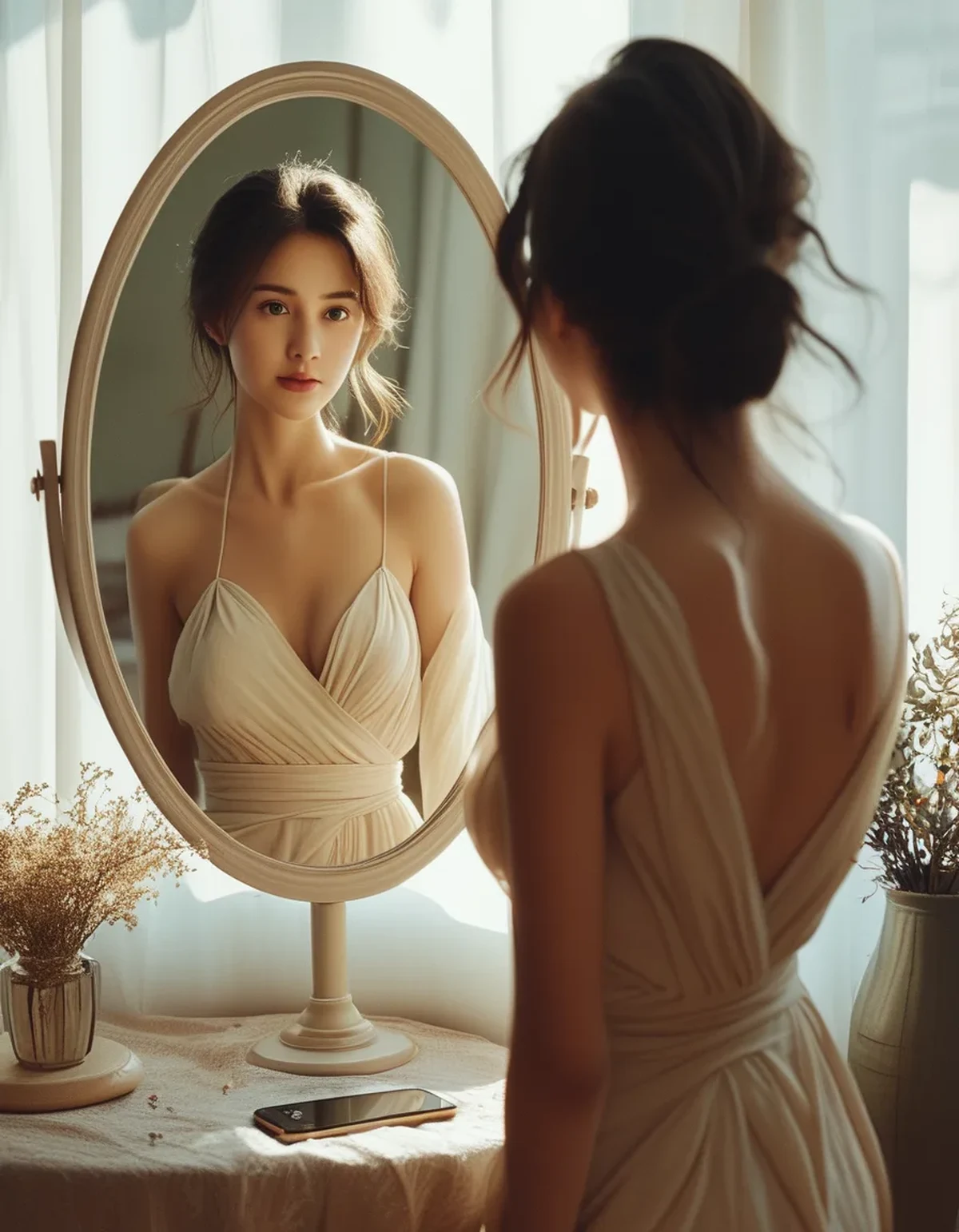
You look at a mirror actively - your eye saccades across the reflection, dwelling where you choose, and your visual system assembles a favourable composite. You also see it in stereo, which gives you depth cues that make drape and volume read correctly.
A photograph is a single frozen instant from one eye’s worth of information, and you look at it all at once, which lets you see the whole silhouette as a shape rather than as a sequence of parts.
Neither is more truthful. The photo is more accurate about silhouette; the mirror is more accurate about how the garment moves and how it reads in three dimensions - which is how other people actually see you. If you are dressing for a room, the mirror is the better guide. If you are dressing for photographs, trust the camera.
What Nobody Tells You About Photographing an Outfit
Overhead light is the enemy of any fitted dress. Downlights carve shadows under the bust, at the waist seam, and across the hip, which reads as bulk. Turn toward a window and the same dress smooths out completely. Light direction changes apparent shape more than the garment does.
Fabric sheen photographs about one value brighter than it appears in person. Satin, sequins, and technical fabrics all pick up more highlight on a sensor than in the eye. A dress that reads subtly lustrous in a room can read shiny in a photo.
Motion hides what stillness reveals. Photographs freeze; real life does not. A drape that looks slack in a still frame may be moving beautifully in a room. This is the single largest source of unfair verdicts on fluid dresses.
Your posture changes the instant the camera goes up. People brace, square their shoulders, and lock their knees. That is not how you stand at a party, and it is not the silhouette the dress was designed around.
A five-second video is more honest than any photo. Set the phone at chest height, step back, walk toward it and turn. You will learn more about a dress in that clip than in twenty stills, and it captures the movement the camera otherwise deletes.
How should you actually evaluate a dress?
A three-part method that takes under five minutes.
Mirror, at distance. Step back at least six feet from a full-length mirror - most people stand two feet away and evaluate a dress they can only see in pieces. Distance shows you silhouette.
Photo, done properly. Phone propped at chest height, level, six or more feet away, telephoto if available, facing a window rather than under downlights. Take one standing, one seated, one from the side.
Video, walking. Ten seconds, toward and away. This catches hem behaviour, whether the skirt swings or clings, and whether a wrap or a slit does anything you would rather it did not.
Then judge across all three. A dress that survives all three is genuinely good. A dress that fails only the badly-shot photo was never the problem.
FAQ: Dress and Camera Questions, Answered
Why do I look wider in photos than in the mirror?
Largely lens compression at wide angle plus a lens height above your centre of mass. Both broaden the torso and shorten the legs. Distance plus telephoto plus chest-height lens removes most of the effect.
Should I trust the shop’s fitting room mirror?
With suspicion. Many retail mirrors are tilted back a few degrees, which lengthens the reflection, and retail lighting is often warm and directional in a flattering way. Photograph the dress in the fitting room and look at the picture at home in daylight before deciding.
Does a dress that photographs badly still work in real life?
Often, yes - particularly fluid fabrics, which need movement to make sense. Conversely, some dresses that photograph brilliantly are stiff and unforgiving to actually wear. Decide based on where you will be wearing it, not on which image is more flattering.
TL;DR:
- Phone cameras are wide-angle, which expands what is nearest and distorts proportion at close range.
- Lens height sets the geometry: chest height and level is neutral, anything higher shortens the legs.
- Your brain edits mirror images in your favour and does not edit photographs, so the two disagree by design.
- Evaluate with all three - mirror at six feet, a properly-shot photo, and a ten-second walking video.
Most dresses accused of looking wrong in a photo were shot at 24mm from three feet under a ceiling light, which would make a couture gown look questionable. Fix the method before you doubt the dress.
Keep Reading
This article is for general styling and informational purposes only. Trends, sizing, availability and pricing may vary by brand and season.