Why a Dress Waist Seam Sits Too High or Too Low on You
Quick Answer: A dress waist seam sits too high or too low because the bodice was cut for a torso length that isn’t yours. Sizes change the width of a dress far more than its length, so going up or down a size barely moves the seam. Measure from the bone at the base of your neck down to your natural waist, compare it with the bodice, and look for petite or tall cuts, adjustable waists or styles with no waist seam at all.
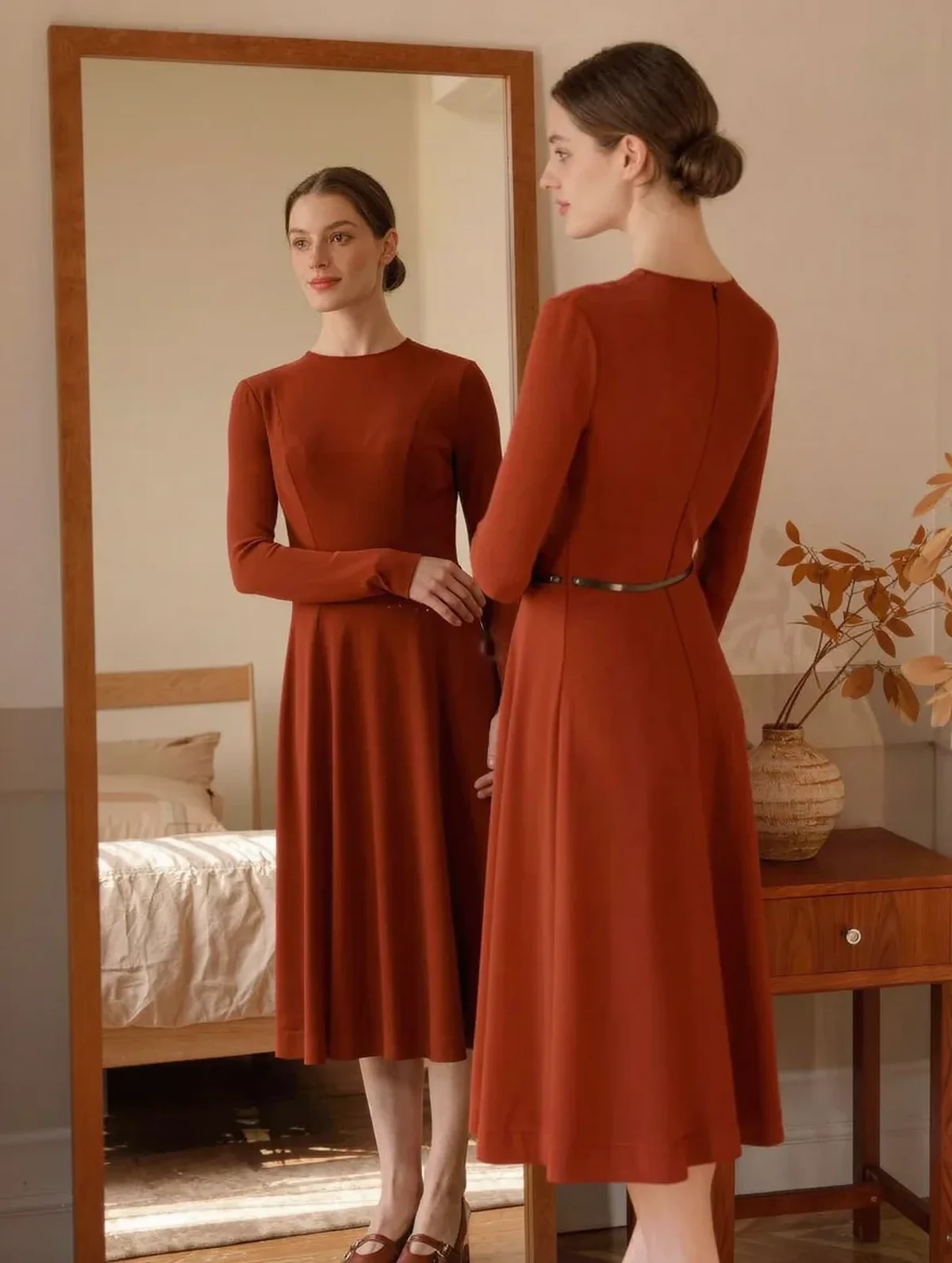
The dress fits everywhere. Shoulders, bust, hips, all fine. Then you look in the mirror and the waist seam is cutting across your ribs like a belt on a toddler, or drooping somewhere near your hip bones.
You try the next size. The seam stays exactly where it was, and now the shoulders are too big as well.
Why does the waist seam on a dress sit too high or too low?
Because the pattern was drafted for one torso length, and yours is different. Every dress with a seam at the waist is built around a back-waist measurement: the distance from the bone at the base of the neck down to the natural waist.
Brands pick one number for each size and cut thousands of dresses to it. If your own measurement is 2 or 3 centimetres longer, the seam rides up towards your ribs. If it’s shorter, the seam drops and the bodice pouches above it.
Height alone doesn’t tell you which way you’ll go. Two women who are both 165 centimetres tall can differ by several centimetres in the torso, with the difference made up in the legs. That’s why a dress that looks right on a friend of the same height and size can look odd on you.
How do you find your natural waist and measure your torso?
Bend sideways, and the crease that forms is your natural waist. It’s usually the narrowest part of the torso and often sits a little above the navel, higher than where most trousers sit.
To measure, you need a tape and ideally a second pair of hands:
- Tie a piece of string or thin elastic around your natural waist and let it settle.
- Tip your head forward and find the bone that sticks out at the base of your neck.
- Measure straight down the spine from that bone to the string.
Write the number down and keep it in your phone. Then measure a dress that fits you well, from the centre back neckline to the waist seam, and you have a personal reference to compare against anything new. A dress with a low back neckline will measure shorter, so compare like with like.
Does going up or down a size move the waist seam?
Barely. Between one size and the next, the chest, waist and hip usually change by a few centimetres each, while bodice length often changes by well under 1 centimetre.
So sizing up to chase a lower seam mostly gives you wider shoulders and a loose bust. Sizing down to lift a droopy waist makes everything tighter and leaves the seam more or less where it started.
The fix is a different cut, not a different size. Petite ranges are generally drafted for shorter frames and have a shorter bodice. Tall ranges add length through the body as well as the skirt. You don’t have to be short or tall overall to need one of them; a long-legged woman of average height often fits a petite bodice best.

Myth vs Fact: Waist Seams
Myth: If the waist is wrong, the dress is the wrong size. Fact: Size is about circumference. The waist seam is about length. A dress can be your size and the wrong length at the same time.
Myth: A belt will hide it. Fact: A belt sits where you put it, but the seam stays where it was sewn. If the two are more than about 2 centimetres apart, you get a visible ridge above or below the belt. A wide belt can cover a small mismatch; a narrow one points straight at it.
Myth: Empire waists are just badly placed waist seams. Fact: An empire seam is meant to sit right under the bust, well above the natural waist. The trouble only starts when a seam designed for the natural waist lands halfway between the two.
Myth: A tailor can move any waist seam. Fact: Raising a seam is often possible. Lowering one usually isn’t, and the reason is in the next section. This is the one that catches people out after they’ve already bought the dress.
Can a tailor fix a waist seam that sits in the wrong place?
If the seam is too low, usually yes. A tailor can unpick the waist, trim the bottom of the bodice and re-attach the skirt higher. It’s a proper alteration, because zips, linings and darts all have to be reset, so expect it to cost more than a simple hem.
If the seam is too high, the options are thin. Lowering it needs extra fabric in the bodice, and most ready-made dresses have only about 1 centimetre of seam allowance there. There’s nothing to let out.
One easier case: dresses with straps. Shortening the straps lifts the whole bodice, waist seam included, and it’s a quick job. Just check that the neckline and armholes still sit comfortably once everything has moved up.
What should you look for if your torso is long or short?
Pick shapes that let the waist land where your body puts it.
- Wrap and tie-waist dresses: you set the waist yourself each time you tie it.
- Elasticated or shirred waists: the gathered band stretches over a few centimetres of height, so it’s forgiving in both directions.
- Shirt dresses with a separate belt and no seam: nothing is sewn in to argue with.
- Shift, slip and bias-cut dresses: no waist seam at all.
- Knit dresses: the fabric follows your shape instead of a fixed line.
For autumn, this is good news. Sweater dresses and belted shirt dresses are everywhere from September onwards, and both suit a torso that standard bodices don’t.
In the fitting room, raise both arms and then sit down. A seam that’s slightly high when you stand will climb another centimetre or two when you reach, and a low one will fold over itself when you sit.
FAQ: Dress Waist Seam Questions, Answered
Where should the waist seam on a dress sit?
On a dress designed with a natural waistline, the seam should rest at the narrowest part of your torso, where your body creases when you bend to the side. Drop-waist and empire styles are designed to sit lower or higher on purpose.
How do I know if I have a long or short torso?
Measure from the bone at the base of your neck to your natural waist and compare it with the back-waist length on a brand’s size chart, if they publish one. A quicker clue: if waist seams and the waistbands of jumpsuits regularly sit too high on you, your torso is on the longer side.
Is a waist seam that’s 1 centimetre off worth worrying about?
No. A small difference disappears under a belt or simply reads as the style of the dress. It starts to show at around 2 centimetres, when the fabric above or below the seam begins to pull or pouch.
TL;DR:
- A misplaced waist seam comes from torso length, and changing size hardly moves it.
- Find your natural waist by bending sideways, then measure from the base of your neck down to it.
- A tailor can often raise a low seam, but there’s rarely enough fabric to lower a high one.
- Wrap, elasticated, belted and seamless styles let the waist land where your body wants it.
Once you know your own back-waist number, the mystery goes away. You can hold a dress up, check the bodice against a tape, and know before you reach the fitting room whether that seam is going to behave.
Keep Reading
This article is for general styling and informational purposes only. Trends, sizing, availability and pricing may vary by brand and season.